
Moving Solids in a Pipeline Part 1- Laminar vs Turbulent Flow

No one ever wants to talk about unplugging a pipeline and one of the best ways to avoid that discussion is to understand settling velocities. Keeping the solids within a pipeline moving is easy if the solids are slow to settle out of suspension. Slow or non-settling slurries require virtually no agitation to keep solids in suspension, and can therefore be pumped with little regard to minimum pipe velocities. Slurries containing solids that settle quickly are however another story.
As illustrated below, solids within slurries, that easily fall out of suspension, tend to drop to the bottom of a pipe.
Settling of particles under gravity and into pipe wall due to particle/pipe surface attractive forces

Flow Velocity ≤ Particle Deposition Velocity
These solids will form the basis of a pipe blockage if not re-suspended by turbulence or kept rolling along the bottom of the pipe by the fluid velocity. To completely understand the dynamics in play here, we must first look at flow patterns within a pipe.
Fluid moving within a pipe at fairly low velocity tends to travel in organized layers.

The friction imposed by the pipe wall causes the layer directly in contact with the wall to move at the slowest rate. This layer is referred to as the boundary layer.
As you move toward the center of the pipe the drag imposed by the pipe wall has less effect, and each successive layer travels at a higher velocity. ( note; velocity rate used in flow calculations will be the average velocity for all the layers combined).
This flow pattern is referred to a Laminar Flow, and is the most efficient flow pattern used in liquid transfer, but the extremely low velocity at the boundary layer provides a resting place for particles that fall out of suspension.
As we increase the velocity we begin to transition into what is referred to as turbulent flow.
In partially turbulent flow the boundary layer breaks down and becomes unstable.
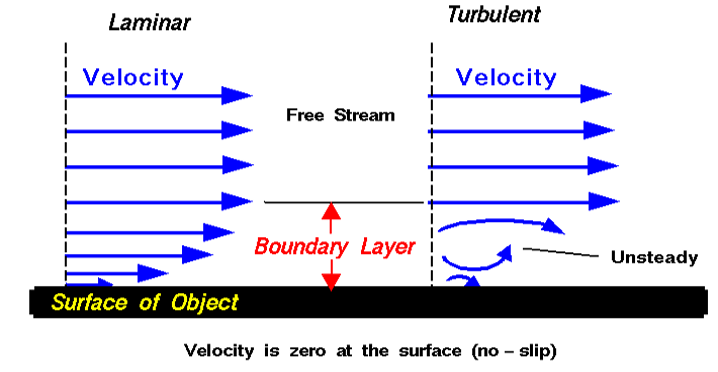
This instability tends to resuspend solids that are falling out of suspension and therefore reduce the likelihood of plugs forming.
As fluid velocity continues to increase we leave the transition zone behind and move into the area referred to as full turbulent flow. In full turbulent flow there is no boundary layer and the entire cross section of the pipe is travelling at similar velocities.
Laminar Flow

Turbulent Flow

The seeming random flow patterns within the pipe result in high friction loss values. This in turn nets poor hydraulic efficiency. There is however a benefit to eliminating the boundary layer, no place for solids to settle. As such, turbulent flow is usually the basis for the transfer of settling solids.
That’s enough for today but in Part 2 of “Moving Solids in a Pipeline” will delve into the four common types of slurries and how the solids travel within the pipe.
Cheers
RJ


Leave a Reply
Want to join the discussion?Feel free to contribute!